Unconstrained face recognition
Large-scale pretraining and staged adaptation improve face recognition under long range, low resolution and other unconstrained conditions.
Staged adaptation for unconstrained recognition
This work treats low-quality face recognition as an adaptation problem. A transformer first learns discriminative representations from a large clean dataset, then adapts to low-resolution and unconstrained imagery through staged fine-tuning.
Larger face crops retain information from the head and hair outline that a tight face crop may discard. Alignment keeps the facial region consistent across pretraining and adaptation.
How it works
- Pretrain a transformer face-recognition backbone on a large aligned face dataset.
- Freeze the backbone and train a new classification head through linear probing, then fine-tune the full model on low-quality data.
- Use enlarged, aligned crops to preserve additional context, alongside the training choices studied in the paper.
Results
The 2025 study reports state-of-the-art results on BRIAR, TinyFace, IJB-S, IJB-B and IJB-C.
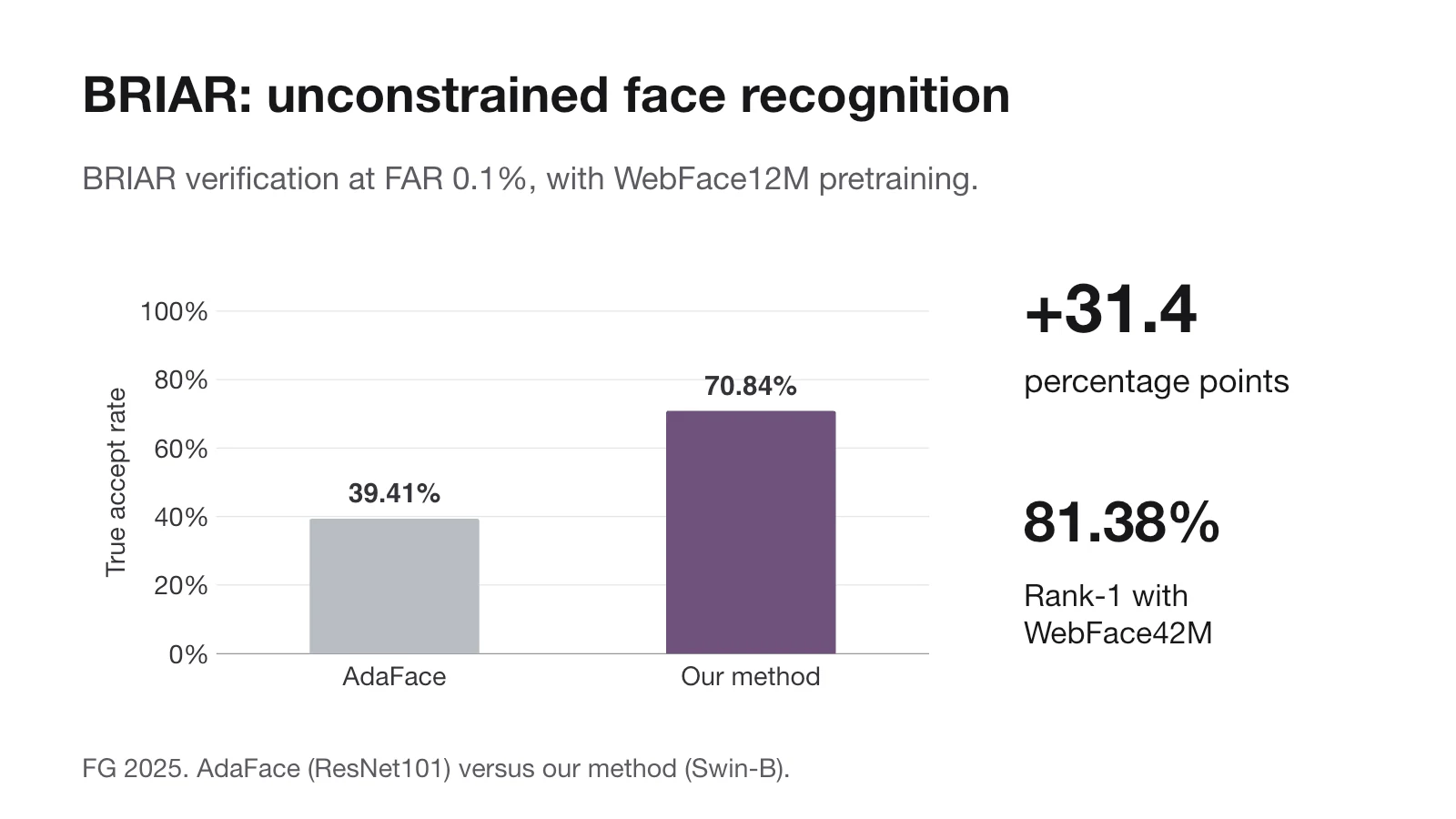
At FAR 0.1%, BRIAR true accept rate increases from 39.41% for AdaFace to 70.84% for our method, a gain of 31.4 percentage points. Both use WebFace12M pretraining, with different architectures: ResNet101 and Swin-B.
A separate Swin-B model pretrained on WebFace42M reaches 81.38% Rank-1.
Contributions
- Combined large-scale pretraining, staged fine-tuning and context-aware crops, achieving state-of-the-art results on five benchmarks in the 2025 study.
- Improved BRIAR TAR at FAR 0.1% from 39.41% to 70.84% relative to AdaFace with WebFace12M pretraining. The compared architectures differ.
- Reached 81.38% Rank-1 with a separate model pretrained on WebFace42M. Co-first author.
Improved Representation Learning for Unconstrained Face Recognition. FG 2025.