CrowdDiff
Conditional diffusion predicts detailed crowd density maps, with multiple hypotheses to improve counting.
Multi-hypothesis density estimation
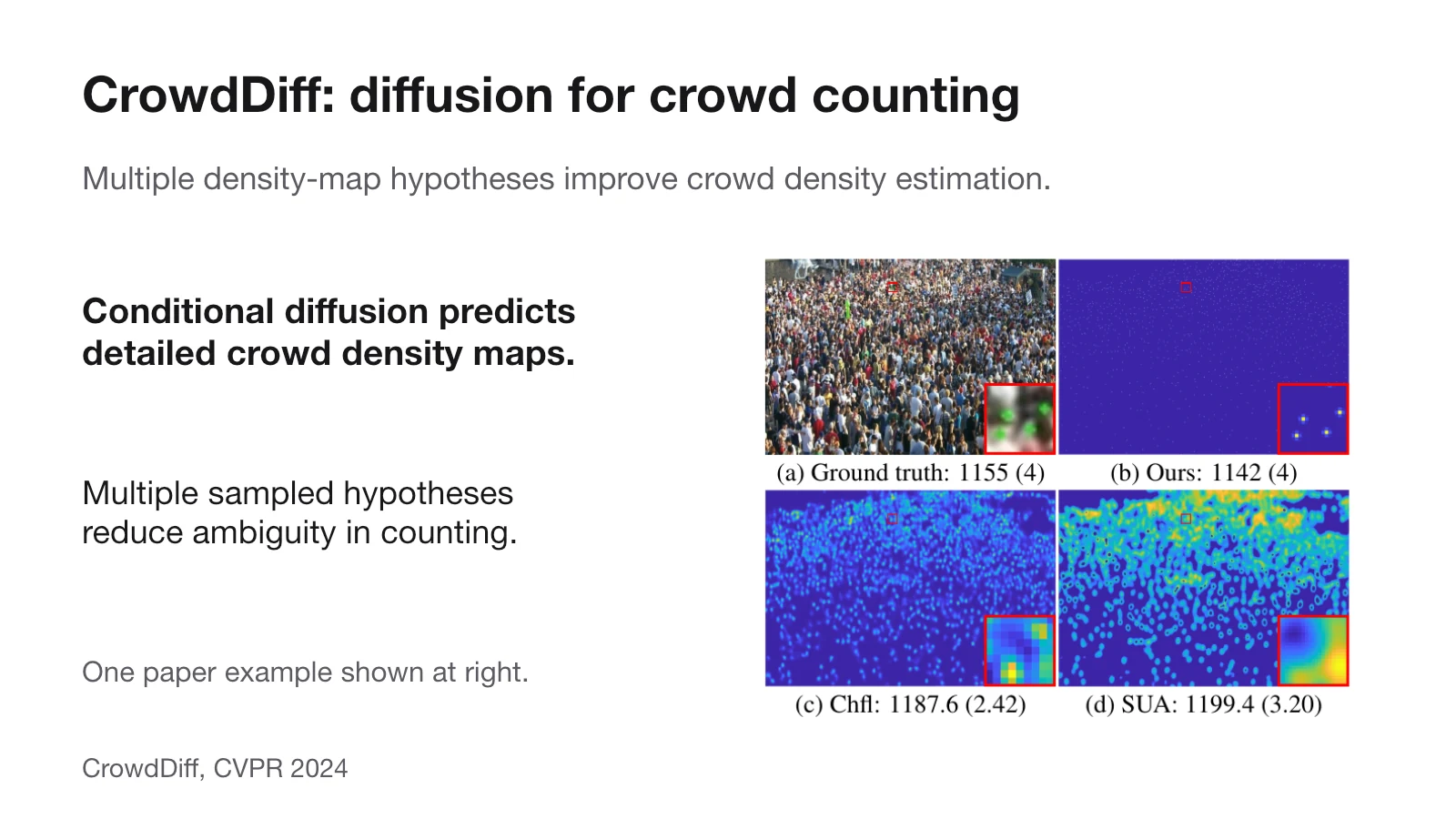
CrowdDiff models a crowd density map as a conditional diffusion output. Repeated sampling produces multiple plausible maps, whose head-location estimates can be fused to improve counting.
The method uses narrow density kernels to retain localized head structure. Its fusion procedure adds new head detections and rejects repeated locations across hypotheses.
How it works
- Train an image-conditioned denoising model on noisy density maps made with narrow kernels. A regression branch supports feature learning during training.
- Sample multiple density-map hypotheses and convert them into crowd maps containing estimated head locations.
- Order the maps by structural similarity and fuse their detections, rejecting duplicate locations using a neighborhood-based radius. Count the resulting head locations.
Results
The paper evaluates diffusion-based density estimation and multi-hypothesis fusion for crowd counting.
The displayed example has 1,155 people in the ground truth and a CrowdDiff estimate of 1,142. These are counts for one image, not an aggregate benchmark score.
Contributions
- Applied conditional diffusion to crowd density estimation.
- Used a regression branch during training to improve feature learning.
- Combined multiple density-map hypotheses to improve counting under ambiguous visual conditions.
CrowdDiff: Multi-hypothesis Crowd Density Estimation using Diffusion Models. CVPR 2024.