GenDeg
Diffusion-generated degradations improve restoration on patterns that the model has not seen during training.
Controlled degradation synthesis
GenDeg is a conditional diffusion model that turns clean images into realistically degraded images. Conditioning specifies both the degradation type and its intensity, so a single clean image can produce varied training examples for restoration.
The clean input remains the restoration target. This creates paired training data without collecting a new real-world degraded/clean pair for every corruption pattern.
How it works
- Condition degradation synthesis on a clean image, a degradation type and an intensity level.
- Generate paired examples across haze, rain, snow, motion blur, low light and raindrops.
- Combine the synthetic pairs with existing paired datasets to form GenDS, then train all-in-one restoration models on the expanded data.
Results
GenDeg contributes more than 550,000 synthetic image pairs across six degradation types. GenDS contains more than 750,000 samples after combining these with existing data.
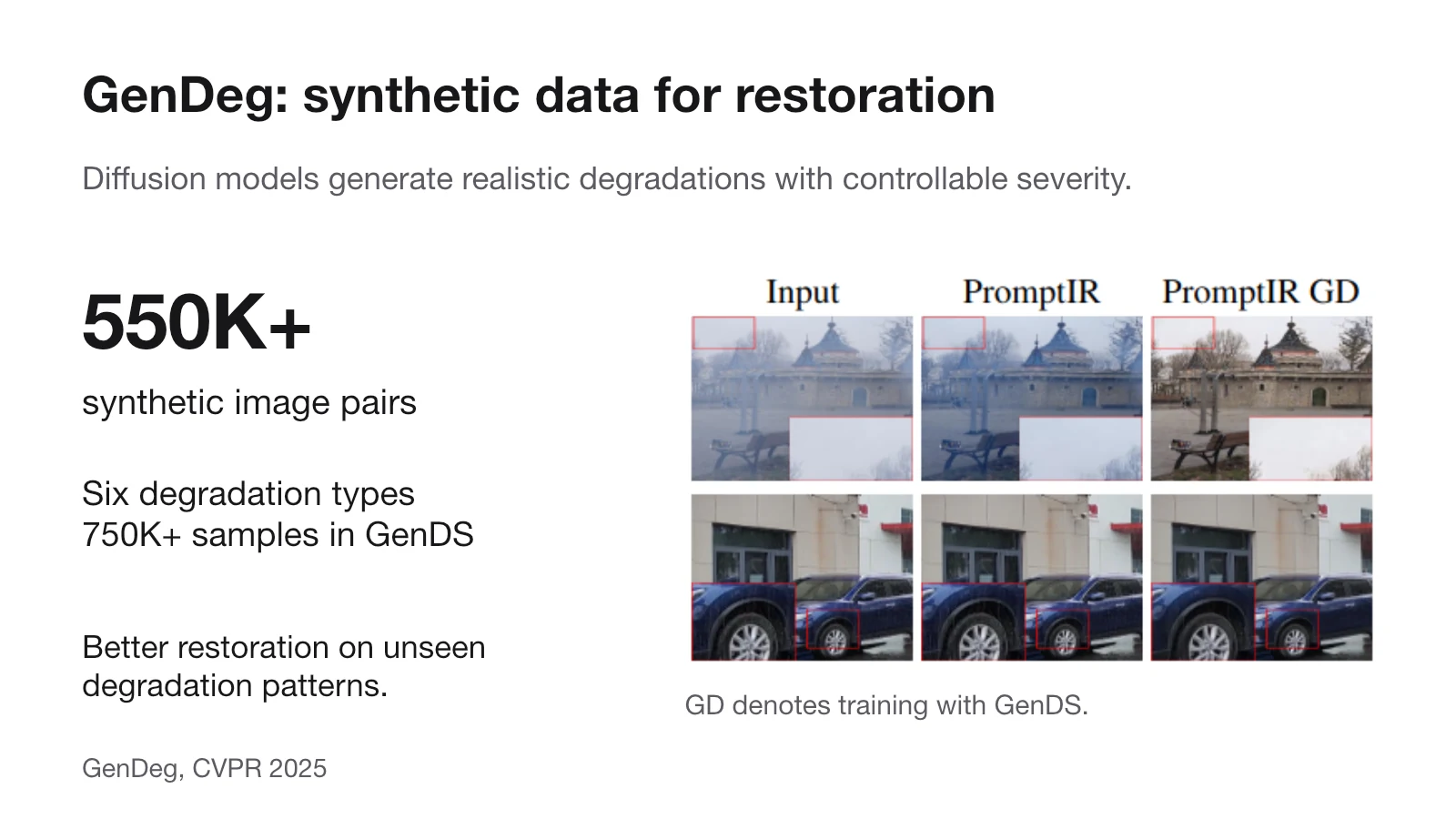
Restoration models trained with GenDS improve on out-of-distribution degradation patterns. The slide compares PromptIR with and without GenDS training on haze and rain examples.
Contributions
- Developed degradation synthesis with control over degradation type and intensity.
- Generated 550K+ synthetic image pairs spanning six degradation types, contributing to GenDS with 750K+ samples.
- Improved the generalization of all-in-one restoration models to unseen degradation patterns.
GenDeg: Diffusion-Based Degradation Synthesis for Generalizable All-in-One Image Restoration. CVPR 2025.