PETALface
Quality-weighted low-rank adapters improve low-resolution recognition while retaining a strong pretrained backbone.
Quality-weighted low-rank adaptation
PETALface adapts a frozen face-recognition backbone using two low-rank adapter branches. An image-quality estimate weights their contributions for each input, allowing adaptation to low-resolution faces while retaining the pretrained representation.
Quality-dependent weighting accounts for the mismatch between clear gallery images and degraded probe images by adapting the contribution of each branch to the input.
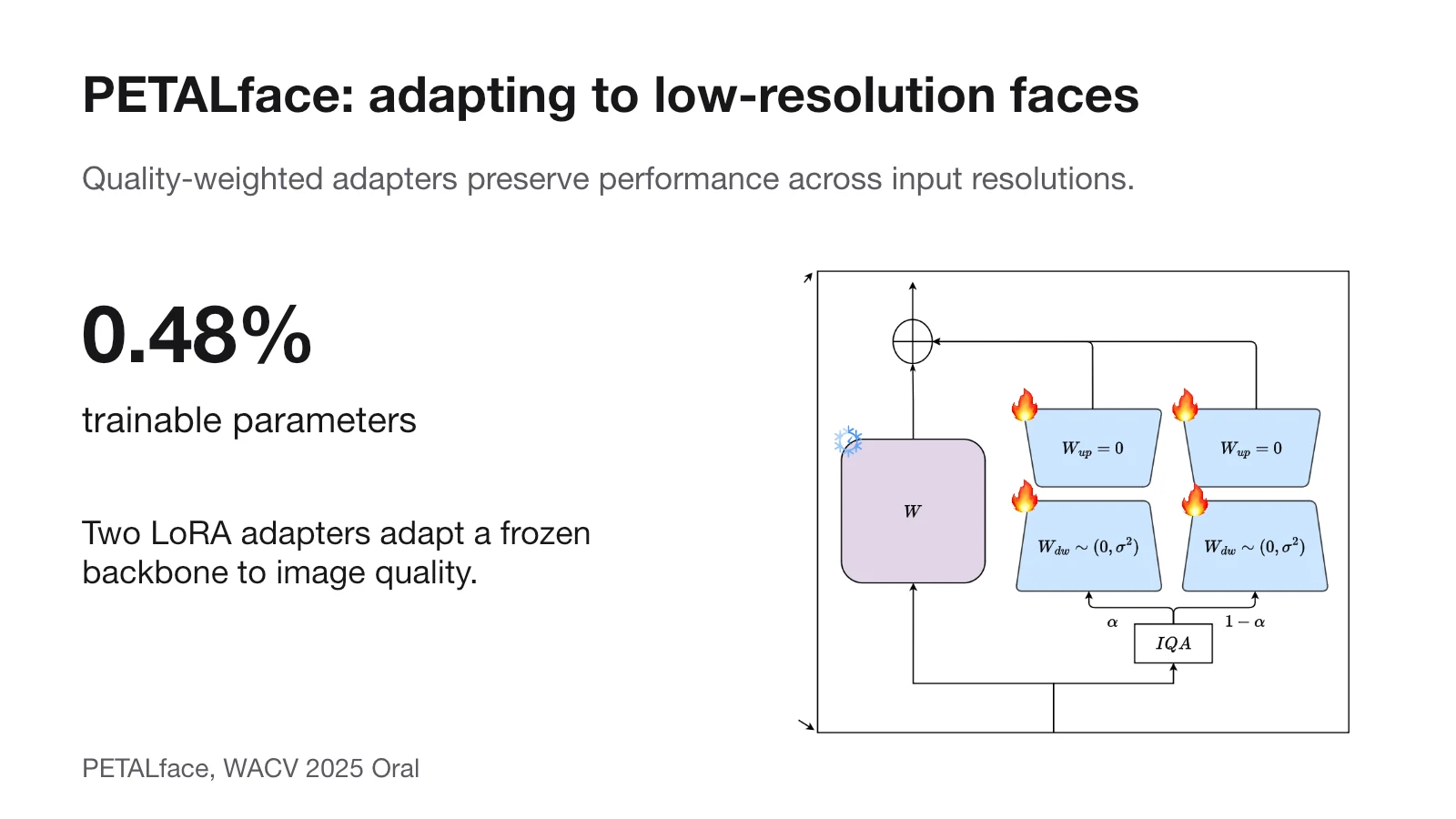
How it works
- Keep the pretrained backbone frozen and attach two trainable low-rank adapter branches.
- Estimate input image quality and use it to weight the two branches.
- Train the adapters for low-resolution recognition and evaluate across low-, high- and mixed-quality datasets.
Results
The adaptation trains only 0.48% of the parameters.
The paper reports stronger low-resolution recognition with competitive performance on high-resolution and mixed-quality benchmarks. PETALface was presented as an oral paper at WACV 2025.
Contributions
- Adapted a frozen face-recognition backbone with only 0.48% trainable parameters.
- Weighted two LoRA branches using image quality to support mixed-resolution inputs.
- Presented as an oral paper at WACV 2025.
PETALface: Parameter Efficient Transfer Learning for Low-Resolution Face Recognition. WACV Oral 2025.